

Home
/
Insights
/
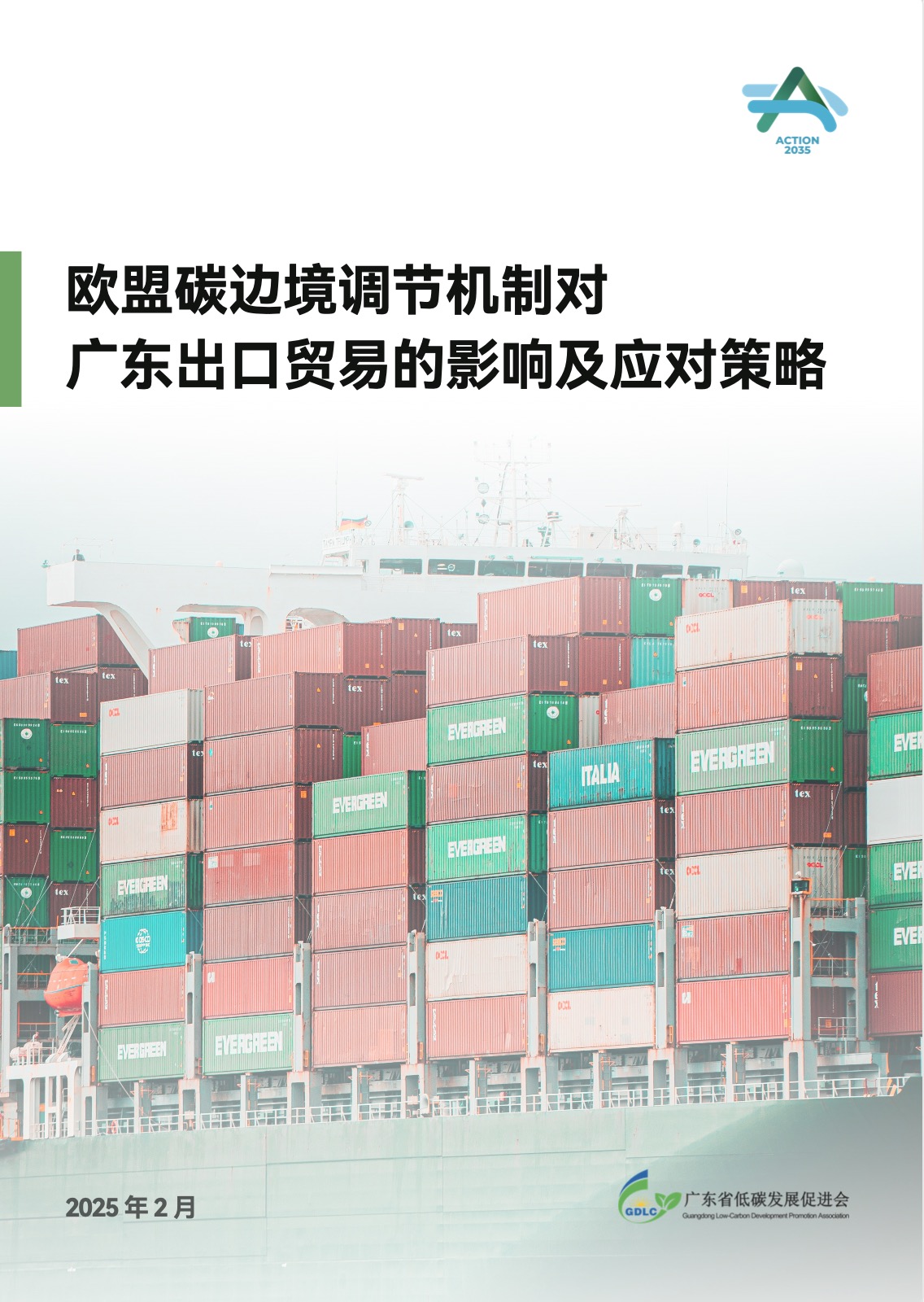
The Impact of the EU Carbon Border Adjustment Mechanism on Guangdong's Export Trade and Response Strategies
The Impact of the EU Carbon Border Adjustment Mechanism on Guangdong's Export Trade and Response Strategies
Chinese
Feb 2025
Report
ACTION 2035 Green Economics Industry Power
Summary:
This report assesses the impact of the EU Carbon Border Adjustment Mechanism on Guangdong's export trade and industrial structure. It analyzes customs trade data to identify directly affected sectors, estimating potential cost implications through carbon emission and pricing calculations, and evaluating current policy and regulatory frameworks. The report aims to understand both immediate disruptions and longer-term structural pressures on the region, while proposing strategic recommendations for government and enterprise adaptation. These recommendations focus on carbon market development, footprint standards, green manufacturing upgrades, supply chain collaboration, and export market diversification.
Related
-
An In-Depth Exploration of Carbon Reduction in the Steel IndustryChina's steel industry has nearly reached its limits in terms of energy efficiency, and large-scale carbon reduction will require breakthroughs in technology, processes, and business models.Interview SEP 2026
-
Decarbonizing Steel Industry Thermal SystemsThis report examines the low-carbon transition pathways for thermal/heating systems in China's steel industry, reviewing the policy drivers behind decarbonization and analyzing the technological trajectory across near-, medium-, and long-term horizons (2025–2060). It surveys and compares the applicability, economics, and emissions-reduction potential of key technologies—including waste heat recovery, system efficiency improvements, and hydrogen-based metallurgy—through in-depth case studies (HBIS Group's hydrogen metallurgy, Shougang Jingtang's process interface optimization, and Sinosteel/CISP's hydrogen-based smelting reduction, among others). It further identifies the practical barriers to scaling these technologies (high green hydrogen costs, renewable energy intermittency, stranded-asset risk, and weak cross-sector coordination mechanisms), and proposes policy recommendations to accelerate the sector's shift toward integration with renewable energy systems.Report AUG 2026
-
Can China’s zero-carbon industrial parks go global?In March 2026, China’s 15th Five Year Plan set a target to build “around 100 national level zero-carbon industrial parks” – zones for industrial production with net-zero or close to zero carbon emissions. It marked an upgrade to what had previously been a series of pilot projects around the country and catapulted such zones to a national priority.Interview JUL 2026
-
Green Power Consumption Faces New ChallengesWith the rapid growth in installed capacity, the core challenge facing the power system is shifting from “whether we can generate more green electricity” to “whether we can effectively utilize green electricity at the right time and place.”Interview JUL 2026

-
iGDP’s Hu Min: How Can We “Access” and “Effectively Utilize” Green Power?The 2026 Summer Davos Forum (the 17th Annual Meeting of the World Economic Forum’s New Champions) recently concluded in Dalian, Liaoning. With “Scaling Innovation” as its theme, the forum brought together more than 1,700 delegates from over 90 countries and regions to discuss five core topics.Interview JUL 2026

-
When Computing Power Starts Competing for Electricity: Why Can Companies Not Access Green Power?AI is driving a new wave of computing infrastructure development and has brought electricity demand to the forefront of industry competition. A seemingly contradictory phenomenon is that while China’s installed capacity of renewable energy is growing rapidly, companies still do not have enough green electricity available.Interview JUL 2026