
Home
/
Insights
/
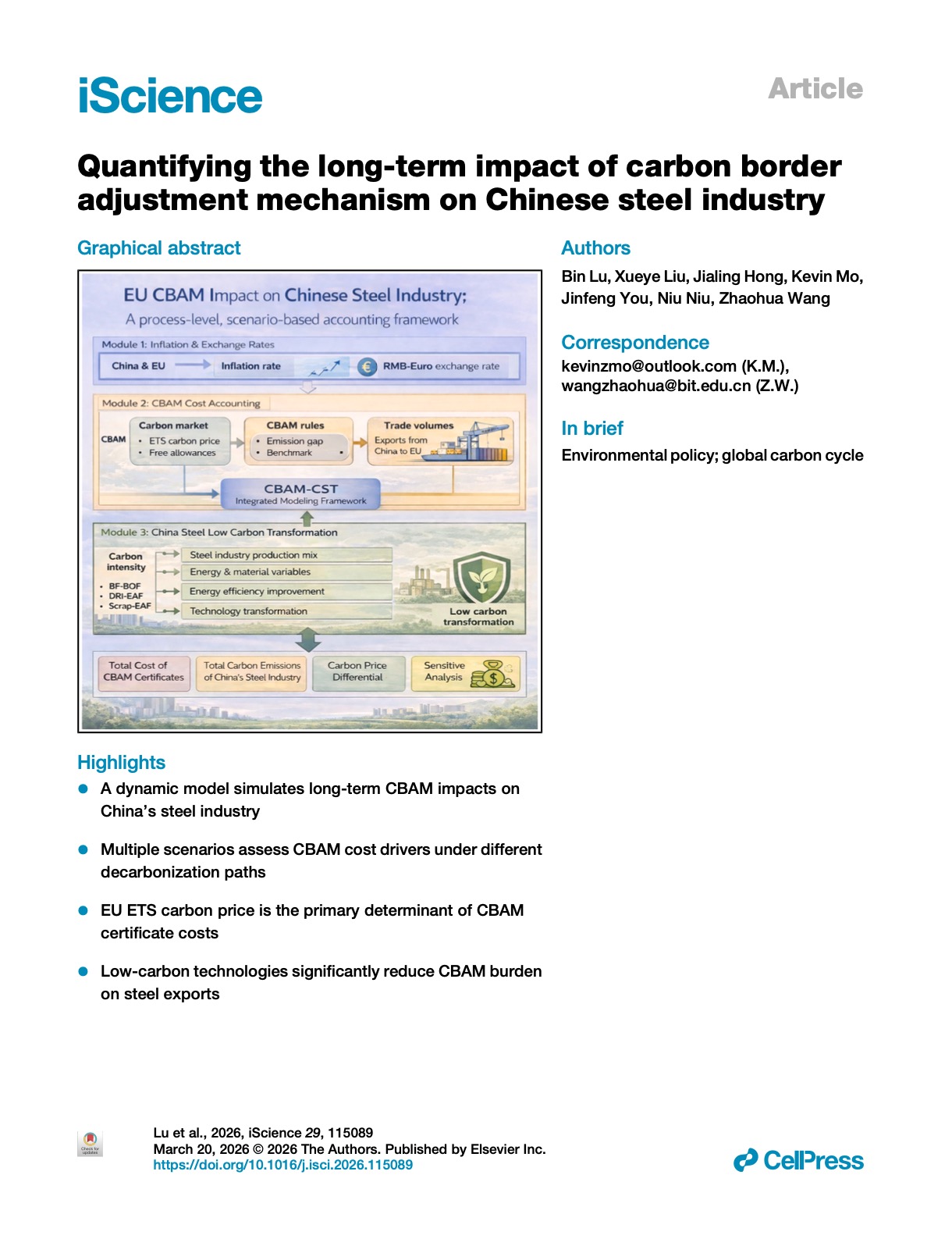
Quantifying the Long-Term Impact of the Carbon Border Adjustment Mechanism on the Chinese Steel Industry
Quantifying the Long-Term Impact of the Carbon Border Adjustment Mechanism on the Chinese Steel Industry
English
March 2026
Academic Journal Article
Green Economics Industry Quantitative Modeling Tools
Summary:
This paper analyzes the long-term impact of the European Union's Carbon Border Adjustment Mechanism (CBAM) on China's steel industry, with a focus on quantifying the resulting cost burden and identifying the key drivers and mitigating factors. It employs a dynamic, process-level scenario-based model that links three steel production routes with their emission intensities, energy transition pathways, carbon pricing systems (EU ETS and China's national carbon market), and trade flows through 2050. The model integrates three sub-modules—inflation and exchange rates, CBAM certificate cost calculation, and China's steel low-carbon transformation—to simulate CBAM obligations across multiple scenarios, with sensitivity analyses examining the effects of EU ETS carbon prices, domestic carbon market inclusion, electricity decarbonization, and hydrogen utilization on total certificate costs.
Suggested citation:
Lu, B., Liu, X., Hong, J., Mo, K., You, J., Niu, N., & Wang, Z. (2026). Quantifying the long-term impact of carbon border adjustment mechanism on Chinese steel industry. iScience, *29*(3), 115089. https://doi.org/10.1016/j.isci.2026.115089
Related
-
An In-Depth Exploration of Carbon Reduction in the Steel IndustryChina's steel industry has nearly reached its limits in terms of energy efficiency, and large-scale carbon reduction will require breakthroughs in technology, processes, and business models.Interview SEP 2026
-
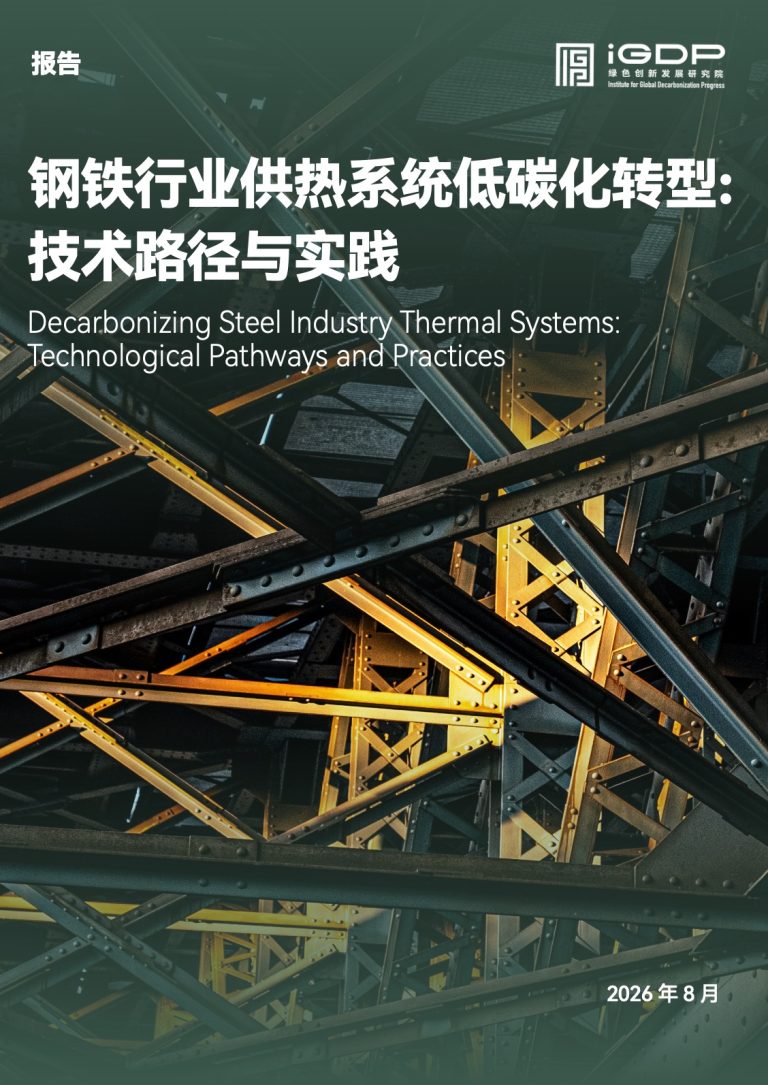
Decarbonizing Steel Industry Thermal SystemsThis report examines the low-carbon transition pathways for thermal/heating systems in China's steel industry, reviewing the policy drivers behind decarbonization and analyzing the technological trajectory across near-, medium-, and long-term horizons (2025–2060). It surveys and compares the applicability, economics, and emissions-reduction potential of key technologies—including waste heat recovery, system efficiency improvements, and hydrogen-based metallurgy—through in-depth case studies (HBIS Group's hydrogen metallurgy, Shougang Jingtang's process interface optimization, and Sinosteel/CISP's hydrogen-based smelting reduction, among others). It further identifies the practical barriers to scaling these technologies (high green hydrogen costs, renewable energy intermittency, stranded-asset risk, and weak cross-sector coordination mechanisms), and proposes policy recommendations to accelerate the sector's shift toward integration with renewable energy systems.Report AUG 2026
-
Can China’s zero-carbon industrial parks go global?In March 2026, China’s 15th Five Year Plan set a target to build “around 100 national level zero-carbon industrial parks” – zones for industrial production with net-zero or close to zero carbon emissions. It marked an upgrade to what had previously been a series of pilot projects around the country and catapulted such zones to a national priority.Interview JUL 2026
-
Consumption Constraints in Green Hydrogen Amino Acid IndustryExamines the green hydrogen, ammonia, and methanol industry in China, contends that the sector is shifting from a supply-side capacity-expansion phase to a "demand-constrained" phase where commercial viability depends on forming a closed-loop offtake and consumption system, identifies critical bottlenecks—including high production costs (2–3 times higher than conventional routes), insufficient port refueling infrastructure, heavy reliance on volatile international certification (e.g., ISCC) and external demand, and the failure of green premiums to translate into stable domestic willingness-to-pay—and proposes a strategic policy reorientation from merely "building production capacity" to actively "creating demand" through enforceable domestic demand-side mechanisms (e.g., non-electric consumption targets, green procurement, and carbon market integration), enhanced domestic green certification and pricing capabilities, consumption-side incentives, and stricter project screening focused on commercial closure, in order to unlock the industry's low-carbon value, reduce dependence on external rules, and support its sustainable commercial scaling and contribution to China's energy transition.Commentary JUN 2026
-
The EU Pushes for Domestic Manufacturing: Where Will China’s Clean Technology Products Go?In its document, the European Commission explicitly stated that China accounts for more than 80 percent of global production capacity in the battery manufacturing and solar photovoltaic sectors; at the same time, the European wind power industry is facing cost pressures from low-priced imports from China. On April 27, China’s Ministry of Commerce responded by stating that the bill constitutes “serious institutional discrimination” and will undermine fair competition.Interview JUN 2026
-
Behind China’s Boom in ‘Zero-Carbon Industrial Parks’As the parks multiply, unified standards and better carbon accounting are needed to maximize their potential.Op-ed APR 2026