
Achieving Just Transition in China's Coal Resource-Based Regions
English, Chinese
JUL 2023
Policy Brief
CCNT Just Transition Subnational Climate Action
Summary:
This policy brief examines the challenges and pathways for achieving a just transition in China's coal-dependent regions as the country pursues its dual carbon goals. It focuses on four critical dimensions that require coordinated action: fostering high-quality economic development through industrial diversification, safeguarding livelihoods and employment security for coal workers and vulnerable communities, managing the phased reduction of coal production while maintaining energy supply stability, and strengthening environmental restoration in mining areas. The policy brief draws on domestic and international experiences to outline a dual-stage transition strategy—first upgrading existing coal operations with smarter and cleaner technologies, then leveraging regional resources to cultivate renewable energy and complementary green industries. It also stresses the importance of robust social safety nets, worker retraining programs, and ecological rehabilitation measures such as repurposing abandoned mining lands for clean energy projects and carbon sinks. The policy brief argues that proactive planning, dynamic capacity adjustment mechanisms, and integrated multi-energy supply systems are essential to mitigate the socioeconomic and environmental impacts of the coal industry's decline, ensuring that the transition is both equitable and sustainable.
Suggested citation:
Yang Li. (2023). Achieving Just Transition in China's Coal Resource-based Regions. Report. Beijing: Institute for Global Decarbonization Progress (iGDP).
Related
-
In-Depth: China’s New Energy Sector Moves Beyond “Scale Worship”On July 23, the National Development and Reform Commission and the National Energy Administration released the “15th Five-Year Plan for Renewable Energy Development” (hereinafter referred to as the “Plan”), which sets out a systematic roadmap for the development of renewable energy over the next five years.Interview JUL 2026
-
The Online Carbon Neutrality Information Database CCNT 2.0 Officially LaunchedOn June 24, 2026, the Institute for Green Innovation and Development (iGDP) hosted the launch event for Zero Carbon Record 2.0 and a forum on progress toward the “dual carbon” goals.Interview JUL 2026

-
Mid-Year Review of Climate Governance: Extreme Weather, Geopolitical Rivalry, and Industrial PressuresWe are nearly halfway through 2026. Global warming is steadily approaching the 1.5°C threshold, and extreme weather events are becoming increasingly “commonplace.” As China kicks off its 15th Five-Year Plan, the goal of reducing carbon intensity faces the practical pressure of “sluggish progress in the first half of the year”—global climate governance has reached a complex and critical crossroads.Interview JUN 2026
-
iGDP Report: China’s Green and Low-Carbon Transition Shows Regional DifferentiationAccording to Yang Li, deputy director of the Institute for Green Innovation and Development (iGDP), who spoke with a reporter from *China Energy News*, the report aims to track the implementation outcomes of local “dual carbon” targets and thereby provide a research foundation and decision-making support for promoting coordinated regional development and guiding localities to advance green transitions based on their own endowments and in accordance with local conditions.Interview JUN 2026

-
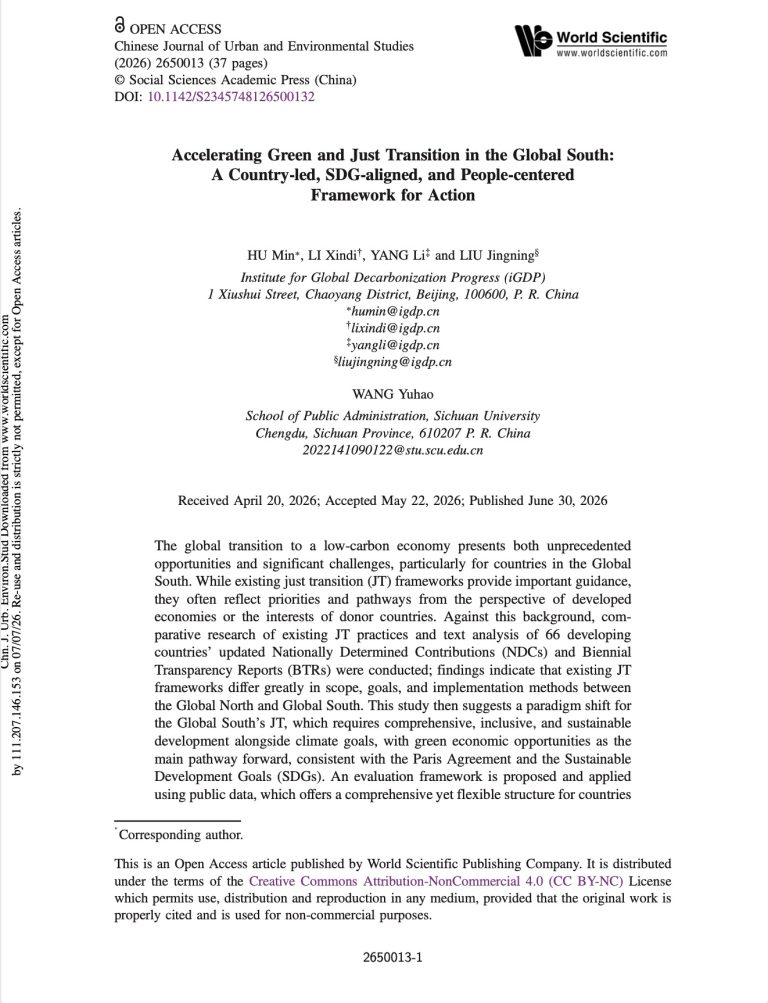
Accelerating Green and Just Transition in the Global SouthThis paper argues that just transition (JT) frameworks built for developed economies don't fit the realities of the Global South — where the challenge isn't just managing the decline of fossil fuel industries, but industrializing, expanding energy access, and reducing poverty while also decarbonizing. The paper reviews major existing JT frameworks (UNFCCC, EU, G20, China, Brazil) and analyzes the climate plans (NDCs) and transparency reports of 66 developing countries to see how JT is actually being defined and pursued on the ground. From this, it builds a new evaluation framework organized around three pillars — Goals (where countries want to end up, climate and development-wise), Pathways (how they're getting there, e.g. green jobs, investment, industries), and Readiness and Capacity (whether they have the social safety nets, finance, and institutions to pull it off) — then tested this framework against real country data to show it can help identify gaps and guide more tailored, country-led policy.Academic Journal Article JUN 2026
-
China Carbon Neutrality Tracker 2025 Annual ReportThis report tracks and quantitatively assesses the green and low-carbon transition of 30 Chinese provincial-level regions over the decade from 2013 to 2022 using the Subnational Low-Carbon and Green Index for China (Subnational LOGIC), which encompasses 26 indicators across four categories: carbon productivity; carbon emissions (covering energy, power, industry, buildings, transport, and agriculture); environmental conditions and land use; and policy systems and public participation. The analysis employs multiple classification frameworks—economic-geographic regions, economic development stages (Pioneer, Leading, Catching-Up, and Developing Economies), national major regional strategies, and energy development positioning—to identify structural divergences in transition patterns. It finds that scores improved across all provinces, with carbon productivity, energy, and power showing nationwide progress while transport, buildings, and industry remain key frontiers for deep decarbonization. The report also presents in-depth case studies of Guangdong, Jiangxi, Shanxi, and Hainan to examine differentiated transition pathways across economic development stages.Report JUN 2026