
August 28, 2026
Beijing
The seminar brought together experts in meteorology, public health, urban practice, sustainable cooling, and communications for in-depth discussions on the meteorological mechanisms underlying increasingly persistent extreme heat, heat-related health and economic risks, sustainable cooling, and practices and challenges in enhancing urban heat resilience.
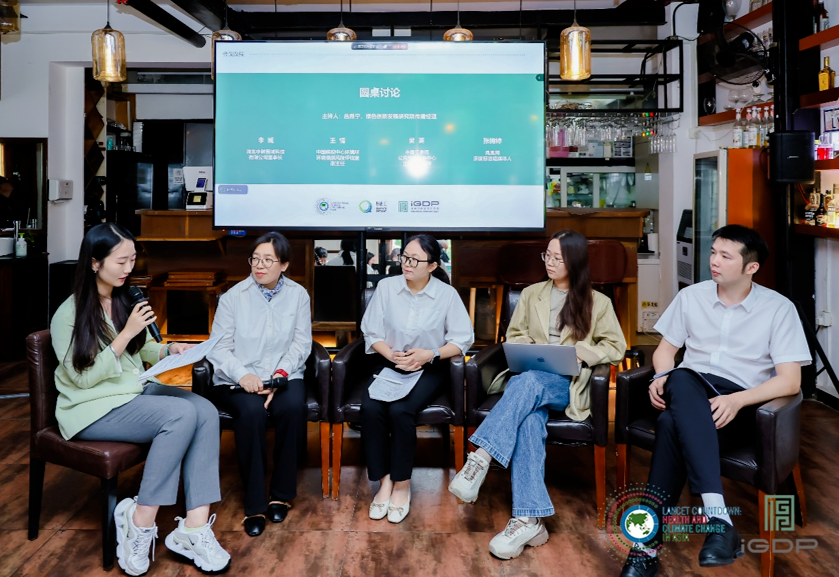
On August 28, 2026, Under the Heat Dome: When Extreme Heat Becomes the Summer Norm — Climate Catalyst Seminar on Enhancing Urban Heat Resilience was held, jointly hosted by the Institute for Global Decarbonization Progress (iGDP) and Lancet Countdown Asia. The seminar brought together experts in meteorology, public health, urban practice, sustainable cooling, and communications for in-depth discussions on the meteorological mechanisms underlying increasingly persistent extreme heat, heat-related health and economic risks, sustainable cooling, and practices and challenges in enhancing urban heat resilience.
Lyu Yaning, Communications Manager at iGDP, moderated the seminar. Wu Ying, Senior Principal Engineer at the Public Meteorological Service Centre of the China Meteorological Administration; Zhao Mengzhen, Associate Professor at the School of Management and Deputy Director of the Department of Public Administration at Beijing Institute of Technology; and Ma Yue, Assistant Analyst at iGDP, delivered a thematic presentation.
01 Thematic Presentations
Wu Ying, Senior Principal Engineer at the Public Meteorological Service Centre of the China Meteorological Administration, analyzed why extreme heat is becoming more persistent from a meteorological perspective. She noted that the geographic extent, frequency, and intensity of extreme heat have all increased in recent years. Against the backdrop of global climate change, factors including high-pressure systems, urban underlying surfaces, topography, and human activities jointly influence the formation of extreme heat. In addition to daytime maximum temperatures, attention should also be paid to the risk of prolonged heat exposure associated with “hot nights.” She also introduced practices involving collaboration between meteorological and disease-control authorities to provide early warnings of heat-related health risks, noting that differentiated risk information for different regions and population groups can improve the precision of heat-health protection.
Zhao Mengzhen, Associate Professor at the School of Management and Deputy Director of the Department of Public Administration at Beijing Institute of Technology, analyzed heat risks from a health economics perspective. She noted that extreme heat can cause physical discomfort, illness, and death, while also affecting socioeconomic conditions through channels such as reduced labor productivity and increased healthcare expenditure. These impacts vary significantly across regions, sectors, and population groups, with low-latitude and low-income areas as well as outdoor workers engaged in high-intensity labor facing greater risks. She emphasized the need to advance mitigation and adaptation actions in a coordinated manner and reduce heat-related health and economic losses through measures such as adjusting working hours and improving cooling conditions.
Ma Yue, Assistant Analyst at the Institute for Global Decarbonization Progress, shared insights into the progress and challenges of sustainable cooling in China. She noted that, as temperatures and cooling demand continue to rise, conventional cooling practices place increasing pressure on energy consumption and greenhouse gas emissions. Sustainable cooling should therefore be advanced through measures including the replacement of high-GWP refrigerants, improvements in equipment energy efficiency, and the deployment of passive cooling solutions. She introduced China's progress in refrigerant substitution, the enhancement of energy-efficiency standards, and local cooling initiatives. Looking ahead, she noted the need to strengthen national-level coordination on sustainable cooling strategies, accelerate the green and high-quality transformation of the cooling industry, improve whole-lifecycle management of refrigerants, and strengthen cooling resilience in cities and communities, thereby promoting more equitable and accessible sustainable cooling services.
02 Roundtable Discussion
Lyu Yaning, Communications Manager at iGDP, moderated the roundtable discussion. Li Wei, Chairman of Hubei Zhongtan Zhicheng Technology Co., Ltd.; Wang Qing, Deputy Director of the Environmental Health Risk Assessment Division of the National Institute for Environmental Health, Chinese Center for Disease Control and Prevention; Wu Ying, Senior Principal Engineer at the Public Meteorological Service Centre of the China Meteorological Administration; and Zhang Meiting, journalist with the In-Depth Reporting Group of ifeng.com, engaged in an in-depth discussion on how cities can enhance heat resilience through early warning, protection, cooling practices, and public communication.
Wu Ying introduced the interdepartmental coordination mechanism between meteorological and disease-control authorities for heat-health risk early warning, as well as the multilevel, progressive service and communication system spanning the national, provincial, municipal, and county levels.
Wang Qing discussed how heat-health risk information can be delivered accurately to populations at heightened risk from the perspectives of disease control and environmental health. She introduced current efforts to promote the application of heat-health risk early warning in typical settings, including schools, elderly care facilities, the logistics sector, and major sporting events, through national and local programs. Measures such as information dissemination in public places and targeted notifications through industry platforms are being used to improve the efficiency of information delivery. She also noted that existing heat-health risk early warnings use differentiated thresholds based on the climatic characteristics of different regions and the adaptability of their populations, with local historical temperature percentiles serving as indicators for warning levels. On this basis, provinces can validate and refine the thresholds within the unified technical framework of national-level early warnings by incorporating more detailed local health and meteorological data, and submit the results for national-level review and confirmation, thereby improving the precision of risk identification and health alerts.
Li Wei shared the practical challenges encountered in advancing urban cooling measures at the local level, drawing on Wuhan's urban cooling initiatives. He noted that urban cooling involves multiple departments, including urban construction, planning, meteorology, water resources, and landscaping. Interdepartmental coordination, financing, space, technology, and public acceptance are all critical issues in implementation. Wuhan has established an interdepartmental working mechanism, translating annual tasks into lists and projects, and adopting approaches including market-based financing, differentiated pilot programs for existing and newly added spaces, and smart spraying systems. At the same time, differentiated response measures are needed in settings such as schools, construction sites, and communities based on the characteristics of different populations and spaces, so as to improve the precision of local responses to extreme heat.
Zhang Meiting shared observations on heat risks faced by outdoor workers from a media perspective, focusing on sanitation workers exposed to high temperatures during work. She noted that uniforms, work systems, and heat protection arrangements used by some sanitation workers still follow management practices developed in the past and are no longer fully suited to an environment in which extreme heat is becoming more frequent. Sanitation workers are also generally older, with some having underlying health conditions, and many engage in prolonged outdoor work; consequently, their vulnerability to extreme heat is often compounded by multiple factors. She also introduced a case from Wuxi in which questionnaires and fabric temperature-rise tests were used to improve standards for sanitation workers' uniforms. She emphasized that uniforms are only one entry point and that it is more important to simultaneously improve working-hour arrangements, labor management, and protection mechanisms under high-temperature conditions. In her view, one important role of the media is to make more visible “who is bearing the cost of heat risk first.”
03 Conclusion
At the conclusion of the seminar, Wang Yujuan, Policy Lead at Lancet Countdown Asia, noted that extreme heat is gradually shifting from an episodic hazard to a summer norm, extending from a meteorological issue into a public health and economic issue. In response to growing cooling demand, cities need to explore sustainable cooling pathways that balance the protection of people's livelihoods, energy security, and low-carbon transition, while strengthening coordination among scientific research, policymaking, industry, and the public.
04 Audience Discussion
Zhang Dong, Senior Project Manager, Social Development Team, China Philanthropy Research Institute of Beijing Normal University: Urban heat resilience refers to a city's capacity to effectively mitigate the impacts of prolonged extreme heat, safeguard infrastructure operations and residents' health, and rapidly restore normal functions. During our research on heat responses in an older residential community in Fengtai District, Beijing, last summer, we observed an interesting phenomenon: several elderly residents living alone in the community spontaneously established a “cooling mutual-aid group.” When someone's air conditioner broke down or someone needed help purchasing heatstroke-prevention medication, they would post a message in the group, and community grid workers and young volunteers would respond as a priority. This seemingly simple neighborhood network was, in practice, more effective than many physical facilities.
Wang Zhaohua, Chief Operating Officer, Hainan Tuoweiruiyin Digital Technology Co., Ltd.: It is an essential component of carbon reduction and an important direction for urban renewal today.
Lu Lu, Researcher, World Resources Institute: Heat risks still require further clarification, while response measures remain fragmented.
Wu Beibei, Senior Principal Engineer and Journalist, Publicity and Science Popularization Centre of the China Meteorological Administration (China Meteorological News): To safeguard high-quality economic and social development and the lives, safety, and well-being of the people, it is imperative to strengthen urban resilience as extreme heat becomes increasingly common. This requires collective action across society.
Liu Shi, PhD Candidate, School of Architecture, Tsinghua University: Urban heat resilience refers to a city's capacity to maintain people's health, safety, and cognitive work capacity through the coordinated regulation of the built environment and individual heat protection under extreme heat, while sustaining the operation of critical urban functions under constrained energy conditions.
Chen Yuexin, Volunteer, Leave No Trace Group, Friends of Nature: Vulnerable people living and working in cities should be able to promptly find nearby places to rest under high-temperature conditions and recover their energy and physical condition.
Chen Yang, Journalist, Green News Department, Southern Weekly: Urban infrastructure should have the flexibility to adapt to different temperatures, protecting the general public without overlooking vulnerable groups.
Qu Sihan, Government Affairs Manager, Solstice Advanced Materials (formerly Honeywell Advanced Materials): Cities need higher-quality building energy efficiency, appliance cooling, and ozone-layer protection to strengthen resilience to extreme heat.
Li Siyin, Assistant Analyst, iGDP: The focus of urban heat resilience lies in the overall adaptation of social systems to extreme heat. This includes, but is not limited to, adaptation of the power system to increased cooling demand and surging electricity consumption caused by high temperatures; building adaptation through enhanced passive cooling capacity; adaptation of logistics and transportation; and health adaptation, including adaptation by populations and public institutions such as medical facilities. These efforts require coordinated action across multiple departments.
Sun Huimin, Editor-in-Chief, Guokr: Under high-temperature conditions, urban infrastructure such as electricity and clean water supplies should ensure basic living needs, impacts on residents' health should be kept within a manageable range, the ecological environment should remain stable, and biodiversity should be maintained.
Chen Yunhan, China Engagement Manager, Climate Bonds Initiative: As the adverse impacts of climate change become increasingly severe, responses to extreme heat need to be incorporated into urban renewal and planning, while protection of vulnerable groups needs to be identified and taken into account.
Wang Jie, Carbon Management Manager, Visionox: From a financial perspective, physical climate risks should be assessed through short-, medium-, and long-term climate stress testing. A China-specific climate-related monetization model repository should be developed through continuous tracking to enable dynamic and proactive responses to urban extreme weather and climate-related disasters.