
Environmental Protection Tax Reform
Chinese
FEB 2016
Report
Green Economics
Summary:
This report provides recommendations for improving China's proposed Environmental Protection Tax, building on expert discussions around the 2015 draft legislation. It argues that the current proposal is overly conservative, essentially mirroring the ineffective pollution fee system it aims to replace, and calls for higher tax rates, expanded coverage, reduced exemptions, and clearer enforcement mechanisms. The report offers twelve specific recommendations across three areas: top-level design to ensure the tax reflects "polluter pays" principles and aligns with macro-fiscal reforms; tax rate and coverage design to meaningfully incentivize emission reductions; and tax collection and management to ensure effective implementation with clear inter-agency coordination.
Suggested citation:
Liu Shuang, Hu Min. (2016). Sharpening the Sword for Ecological Civilization: Recommendations on Environmental Protection Tax Reform. Beijing: Institute for Global Decarbonization Progress (iGDP).
Related
-
The EU Pushes for Domestic Manufacturing: Where Will China’s Clean Technology Products Go?In its document, the European Commission explicitly stated that China accounts for more than 80 percent of global production capacity in the battery manufacturing and solar photovoltaic sectors; at the same time, the European wind power industry is facing cost pressures from low-priced imports from China. On April 27, China’s Ministry of Commerce responded by stating that the bill constitutes “serious institutional discrimination” and will undermine fair competition.Interview JUN 2026
-
The EU’s Carbon Border Adjustment MechanismThis report analyzes the European Union's Carbon Border Adjustment Mechanism (CBAM) as it transitions from its preparatory phase to full implementation, focusing on three critical policy areas with direct implications for Chinese exporters: the recognition of carbon prices paid in producing countries, the potential conditional acceptance of international carbon credits, and the technical alignment between CBAM and the EU ETS free allowance benchmarks. It combines systematic legal review of the CBAM Regulation and its implementing acts with practical policy assessment, drawing on official EU legislative documents, technical studies from the Joint Research Centre (JRC) and the European University Institute (EUI), and expert reports from Adelphi and the Climate Club. The research examines the regulatory texts, identifies remaining uncertainties, and derives forward-looking policy recommendations for Chinese authorities and enterprises.Report APR 2026

-
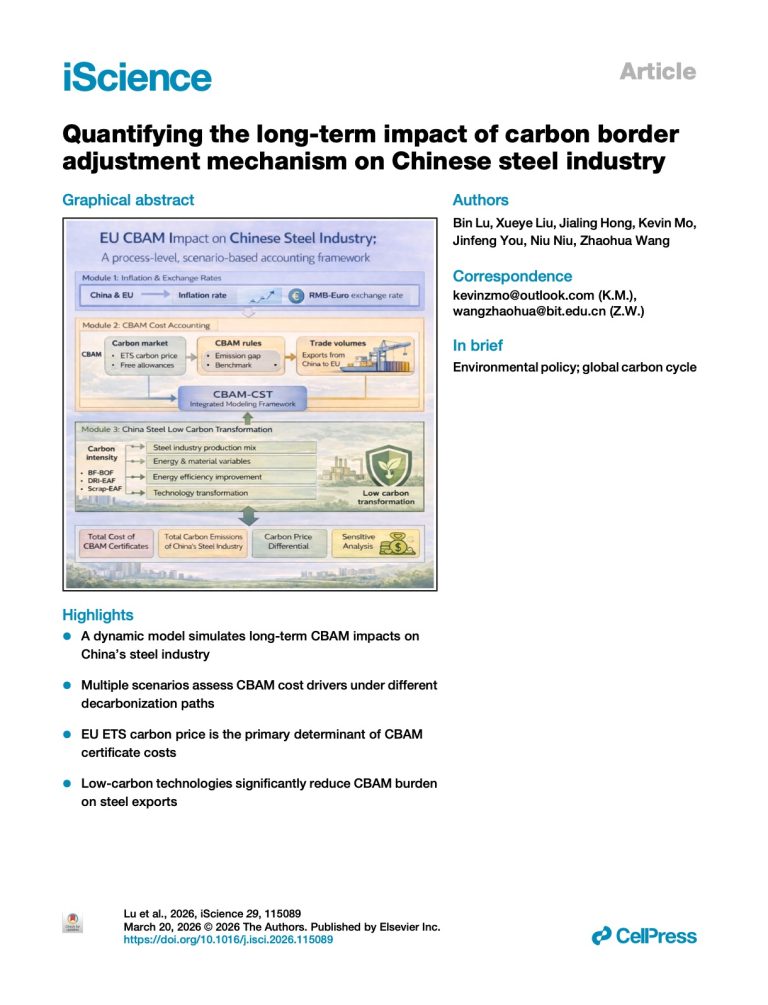
Quantifying the Long-Term Impact of the Carbon Border Adjustment Mechanism on the Chinese Steel IndustryThis paper analyzes the long-term impact of the European Union's Carbon Border Adjustment Mechanism (CBAM) on China's steel industry, with a focus on quantifying the resulting cost burden and identifying the key drivers and mitigating factors. It employs a dynamic, process-level scenario-based model that links three steel production routes with their emission intensities, energy transition pathways, carbon pricing systems (EU ETS and China's national carbon market), and trade flows through 2050. The model integrates three sub-modules—inflation and exchange rates, CBAM certificate cost calculation, and China's steel low-carbon transformation—to simulate CBAM obligations across multiple scenarios, with sensitivity analyses examining the effects of EU ETS carbon prices, domestic carbon market inclusion, electricity decarbonization, and hydrogen utilization on total certificate costs.Academic Journal Article MAR 2026
-
The EU CBAM Takes Effect: What Impact Will It Have on China’s Steel Industry?The EU views the CBAM as a key institutional mechanism for preventing “carbon leakage” and balancing domestic and international carbon costs; however, following the implementation of specific rules, its impact on Chinese steel companies is no longer merely a macro-level risk but has gradually evolved into a practical challenge that must be quantified, accounted for, and addressed head-on.Interview JAN 2026
-
Enhancing the “Green Content” of Energy-Intensive Industries Requires Multi-Dimensional SupportThe expansion of China’s carbon market is the inevitable result of the convergence of multiple national strategic objectives.Interview NOV 2025
-
A Model for Analyzing the Interaction between the European CBAM and the Chinese Steel IndustryThis report presents the CBAM-CST model, a quantitative tool developed to analyze the long-term interaction between the EU Carbon Border Adjustment Mechanism and China's steel industry decarbonization. The model integrates three modules—CBAM cost calculation, China's steel low-carbon transformation, and inflation/exchange rates—to simulate CBAM certificate costs across multiple scenarios through 2050. It identifies EU ETS carbon price and Chinese steel carbon intensity as the primary cost drivers, and examines how low-carbon technologies, electricity decarbonization, and hydrogen adoption can reduce the CBAM burden. The analysis also evaluates the potential offset from China's domestic carbon market and provides technical support for China-EU policy dialogue and enterprise strategy formulation.Report JUN 2025