
Food and Agriculture
The entire food production chain – from production to consumption – is closely related to climate change. On the one hand, agricultural production and animal husbandry are under threat from climate change. Changes in temperature and precipitation brought about by global warming and the frequent occurrence of extreme weather have an impact on agricultural production, grassland yield and livestock carrying capacity. On the other hand, all aspects of food production and consumption, such as food production, processing, transportation, and kitchen waste disposal, are significant sources of greenhouse gas emissions. iGDP contributes to China’s 2060 carbon neutrality goal by identifying the opportunities for greenhouse gas emission reduction in the entire food production and consumption chain, promoting actions to drive down emissions in this sector and develop sustainable agriculture and food system practices.
Featured Projects
2026-06
Working Paper
Food Loss and Waste (FLW) is a pressing issue with far-reaching implications for food security, resource efficiency, and climate change. Globally, FLW across the food supply chain contributes around 8–10% of total greenhouse gas (GHG) emissions and generates substantial economic and environmental costs. In China, FLW remains a significant challenge: iGDP estimates that approximately 430 million tonnes of food were lost or wasted in 2024. The largest volumes of FLW occur during post-harvest handling and storage, as well as at the consumption stage.
Beyond the loss of food and nutrition, FLW carries considerable climate consequences. In 2024, China’s FLW-related carbon footprint was estimated at approximately 500 million tonnes of CO2e. In addition, methane emissions associated with FLW amounted to approximately 185 million tonnes of CO2e. The impacts vary significantly by food type: vegetables account for the largest share of losses, while animal-based products, despite relatively low loss volumes, have disproportionately high emissions intensity. This underscores FLW reduction as a cost-effective, high-potential mitigation opportunity that remains largely untapped.

2025-11
Policy Brief
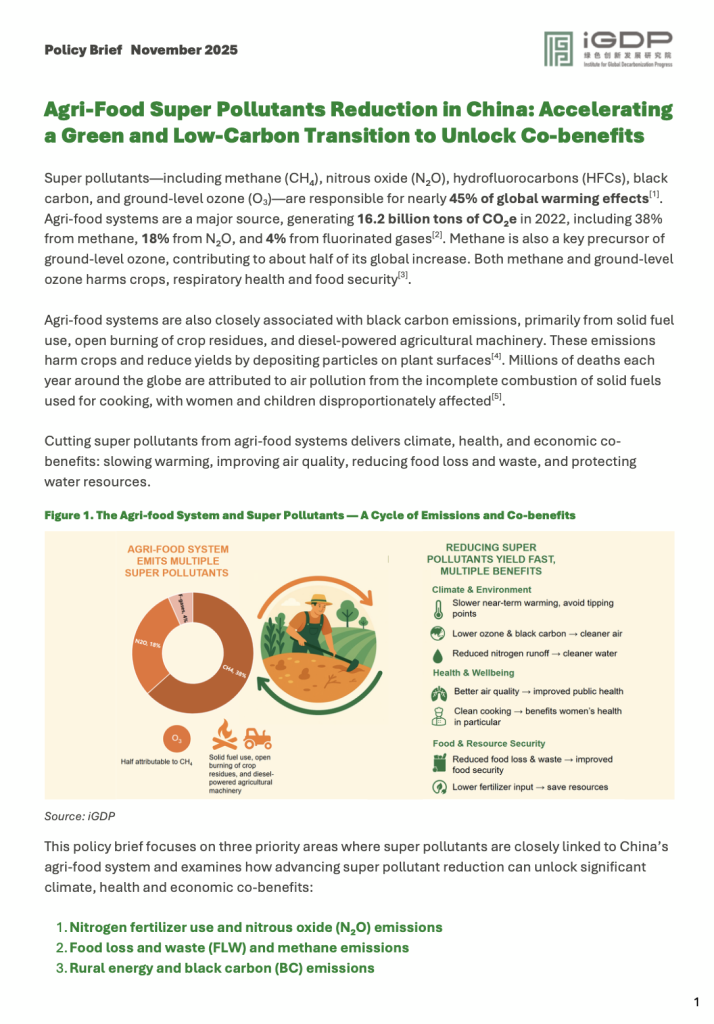
This policy brief examines the critical role of reducing super pollutants—specifically methane (CH₄), nitrous oxide (N₂O), and black carbon (BC)—from China’s agri-food system to unlock significant climate, health, and socio-economic co-benefits, focusing on three priority areas: optimizing nitrogen fertilizer use to cut N₂O emissions, reducing food loss and waste (FLW) to mitigate methane emissions, and transitioning rural energy sources and agricultural machinery to decrease black carbon emissions. It highlights practical solutions such as precision fertilization, sustainable cold chain development, and rural energy electrification, emphasizing their potential to lower greenhouse gas emissions, improve air quality, enhance food security, increase farmers’ incomes, and reduce premature deaths, while also outlining existing policy support, financial mechanisms, and the growing role of new agricultural entities in facilitating this green transition.
2025-11
Policy Brief
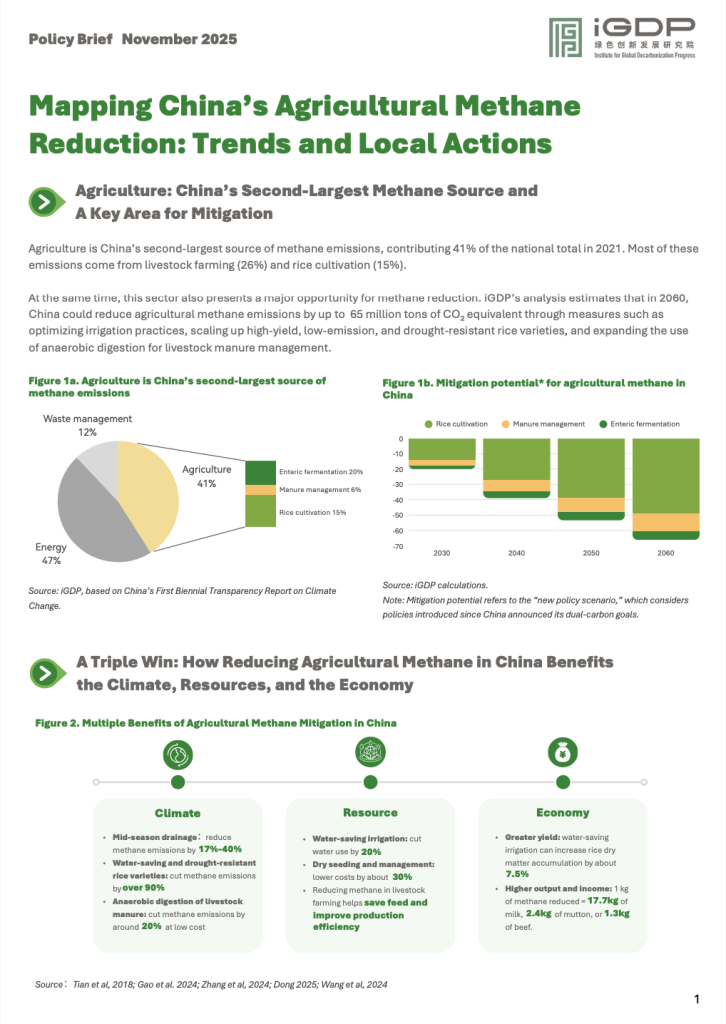
This policy brief provides an analysis of China’s agricultural methane emissions, which constitute the nation’s second-largest methane source. It outlines the significant mitigation potential within the sector, highlighting key trends and provincial-level actions. The brief identifies the top-emitting regions—Hunan, Sichuan, Inner Mongolia, Jiangxi, and Heilongjiang—and details the specific measures nine provinces are implementing, such as optimizing manure management and promoting low-emission rice cultivation. Furthermore, it showcases successful local pilot projects in Sichuan, Yunnan, and Jiangxi that demonstrate the multiple benefits of methane reduction, including climate, resource, and economic gain
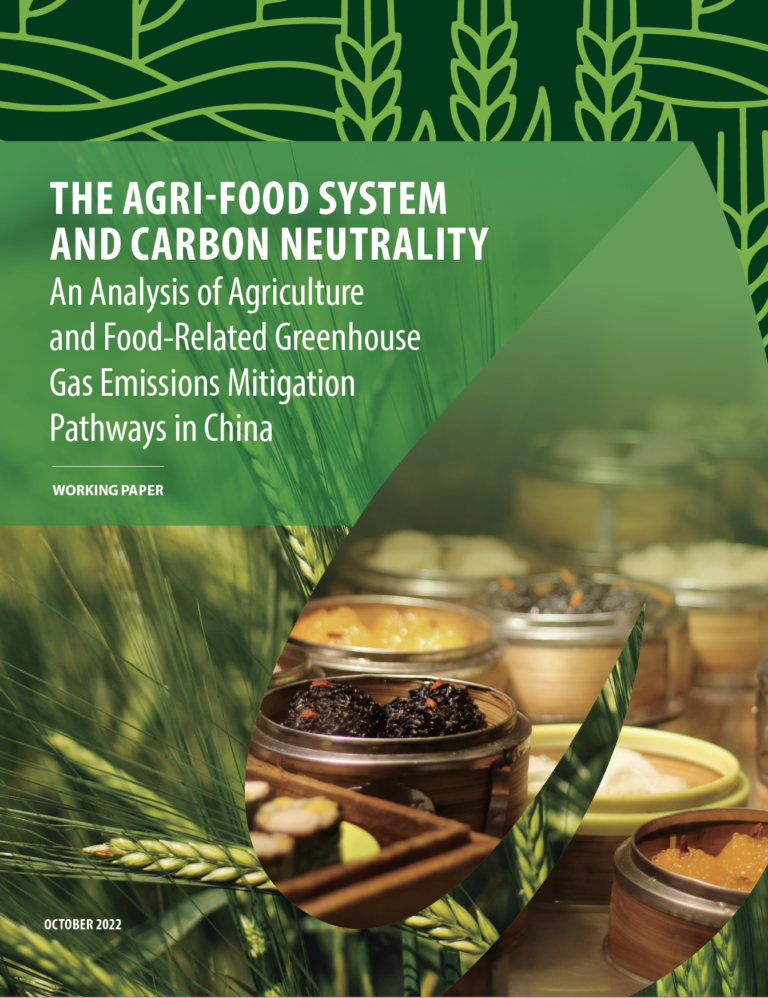
The Agri-Food System and Carbon Neutrality
2023-11-30
Report
To strengthen China’s response to global climate change and achieve the long-term goal of carbon neutrality, it is necessary to have a clear understanding of its agri-food system’s emissions and reduction possibilities. This report estimates China’s agri-food system GHG emissions by source and type, examines existing and new potential reduction efforts, and outlines key pathways and priority measures to achieve carbon neutrality in the agri-food system.
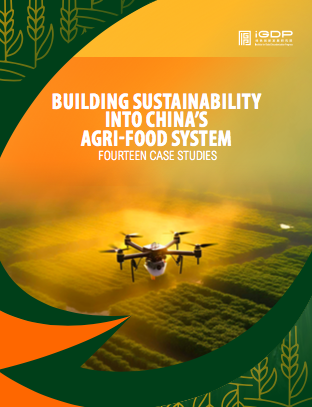
Building Sustainability into China's Agri-food System - Fourteen Case Studies
2023-11-30
Case Studies
This report presents fourteen case studies on actions being taken to drive China’s sustainable agri-food transition. The selection of cases is based on key mitigation actions that have been identified in previous research. They explore local practices under specific abatement actions and briefly analyze the key elements needed for replication. The cases show how different stakeholders in the agri-food system can help achieve emissions reduction through mechanism design and innovation, leading to economic, environmental, and social benefits.
Summary Report on the Emission Reduction Potential of China’s Food System Under Carbon Neutrality