China Carbon Neutrality Tracker 2025 Annual Report
Green and Low-Carbon Transition in China's Provincial Level Regions: A Decade in Review
Report | June 2026
Suggested Citation: Yang Li, Zhu Tongxin, Song Manjiao & Li Xindi. (2026). CCNT 2025 Annual Report: Green and Low-Carbon Transition in China’s Provincial Level Regions: A Decade in Review, Institute for Global Decarbonization Progress (iGDP)
License: Creative Commons Attribution 4.0 International License (CC BY 4.0)

Report Highlights

Executive Summary
As China’s “dual carbon” targets have been enshrined as national strategy and the “1+N” policy framework continues to take shape, the country’s green and low-carbon transition has moved into a phase of accelerated implementation at the subnational level. Given China’s vast territory and the significant differences among provincial level regions in economy, energy mix, and resource endowments, the transition varies notably across regions in terms of starting points, pathways, and outcomes. Therefore, systematically tracking subnational climate action carries significant potential to inform policymaking and ensure the timely achievement of China’s “dual carbon” goals.
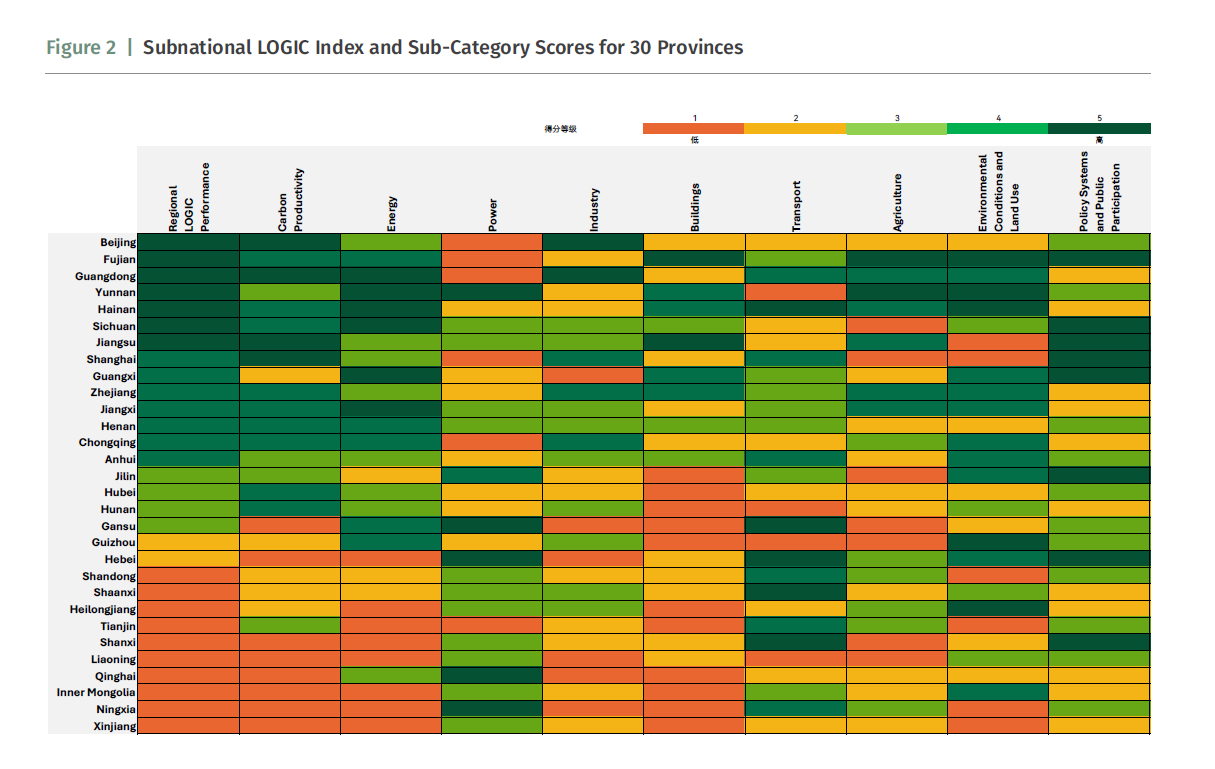
This report applies Subnational Low-Carbon and Green Index for China (Subnational LOGIC), an indicator tool developed by iGDP, to track and quantitatively assess the low-carbon transition of 30 provincial level regions between 2013 and 2022. Subnational LOGIC encompasses 26 specific indicators under four categories: carbon productivity; carbon emissions (including six sub-categories covering energy, power, industry, buildings, transport, and agriculture); environmental conditions and land use; and policy systems and public participation, together capturing the overall quality of regional economic growth and progress on sectoral emission reductions.
As the first year of the 15th Five-Year Plan (15th FYP) period (2026–2030), 2026 will set the trajectory for a planning cycle that will determine whether China stays on course for both basic socialist modernization, a key national goal, and its “dual carbon” climate goals. By tracking subnational implementation of China’s “dual carbon” strategy, this report aims to inform policymaking on coordinated regional development, resource-appropriate green transition, and the evidence-based design of low-carbon development policies for the 15th FYP period.
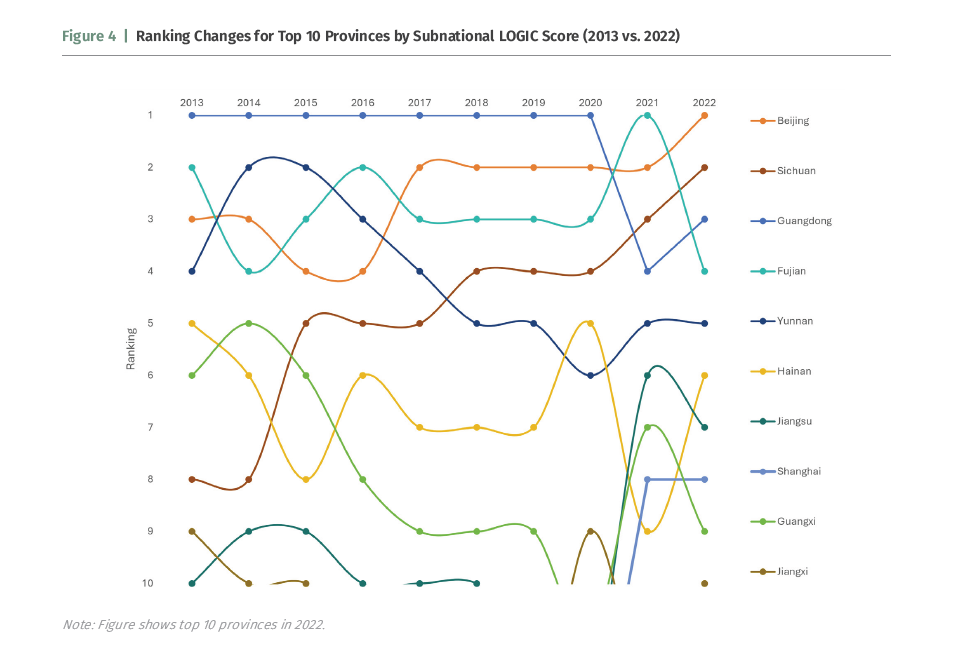
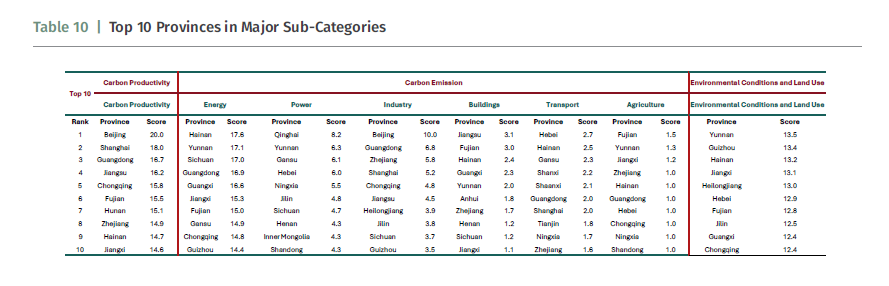
Tracking 30 provincial level regions from 2013 to 2022, Subnational LOGIC shows that green and low-carbon scores improved across all provinces, reflecting progress in regional transition and marking the beginning of an accelerated transition phase. In 2022, leading provinces performed well across all indicators, and each showed distinctive strengths, with no single province dominating in all dimensions. This demonstrates that provinces are charting diverse green development pathways shaped by their own resource endowments, industrial structures, and policy priorities, rather than following a one-size-fits-all approach.
By region, China’s green and low-carbon transition exhibits pronounced structural differences: eastern and economically leading regions excel in carbon productivity and end-use sector decarbonization, but their power scores are constrained by resource endowments, and future efforts should focus on cross-regional energy coordination and low-carbon technology innovation; central regions and areas like the Yangtze River Economic Belt show relatively balanced scores and should pursue deeper decarbonization in end-use sectors through institutional reforms; western regions and large energy bases show marked advantages in power and energy, but need to better translate green power endowments into industrial value added, shifting from resource-based energy suppliers to green industrial powerhouses; northeastern and key energy-supply regions have advantages in environment and land use, with future priorities around upgrading traditional industries and fostering new growth drivers.
By sector, carbon productivity, energy, and power have made progress nationwide, while transport, buildings, and industry remain the primary frontiers for deep decarbonization.
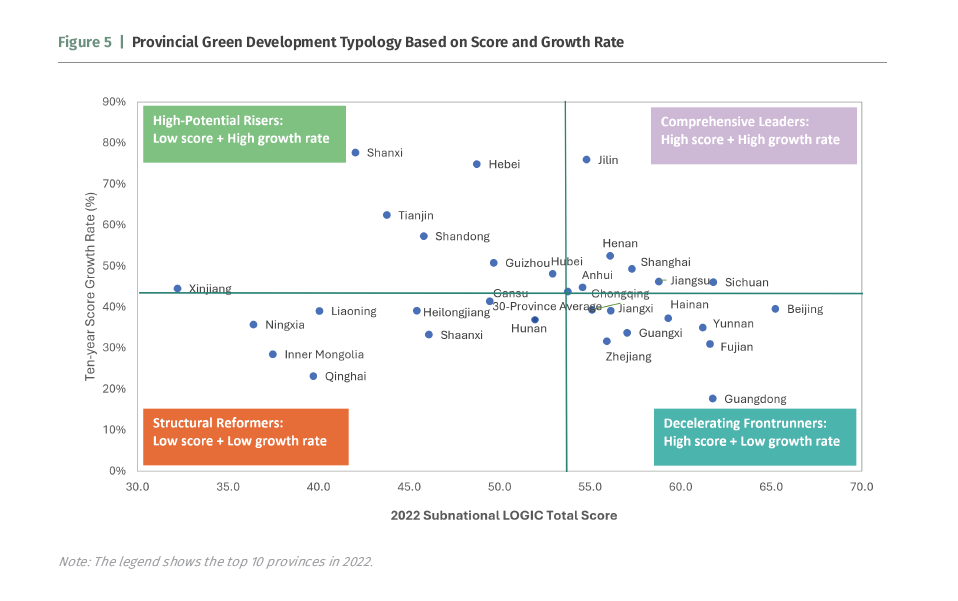
Analysis of Subnational LOGIC scores and growth rates across the 30 provincial level regions reveals four distinct provincial types: Decelerating Frontrunners (high scores & low growth rates), Comprehensive Leaders (high scores & high growth rates), High-Potential Risers (low scores & high growth rates), and Structural Reformers (low scores & low growth rates). Going forward, a differentiated approach should guide policymaking: leading regions should be encouraged to pursue institutional innovation to consolidate transition gains, while provinces with high potential should receive targeted support to fully unlock their green transition potential.
Based on a composite assessment of five indicators—per capita GDP, shares of the primary, secondary, and tertiary sectors, share of manufacturing value-added in total industrial value-added, resident population urbanization rate, and share of primary sector employment—this study ranks provinces from highest to lowest by economic development stage and creates four additional analytical groupings: Pioneer Economy, Leading Economy, Catching-Up Economy, and Developing Economy. Through case studies of Guangdong, Jiangxi, Shanxi, and Hainan, the report examines the differentiated pathways of green and low-carbon transition for regions in these four contrasting stages of economic development. Guangdong, as a Pioneer Economy, leads in carbon productivity and end-use sector decarbonization through industrial structure optimization and clean energy inflows, but local power decarbonization remains a weak point. Jiangxi, as a Leading Economy, has achieved notable results in reducing carbon intensity, but breakthroughs in industrial and transport decarbonization are still needed. Shanxi, as a Catching-Up Economy, has developed a distinctive emissions reduction pathway for coal-dependent areas, but its energy and industrial low-carbon transition still face significant challenges. Hainan, as a Developing Economy, has a relatively clean power mix and an economic structure underpinned by the service sector, but challenges remain in expanding non-fossil power generation and advancing industrial electrification. The experience of these four provinces shows that there is no universal template for green and low-carbon transition; each region should identify bottlenecks and apply targeted measures suited to its development and resource endowments to unlock its unique low-carbon development potential.
Related
This report measures China’s progress toward its climate, environmental, and sustainable development goals, including low-carbon urban development, clean energy transition, and early carbon peaking.