
What Do the “Two Sessions” Signal for China’s Green Transition?
2026/03/05
A Q&A with iGDP Analysts
In this edition of iGDP Insights, we assess climate content in the Government Work Plan and 15th Five-Year Plans documents recently released at the ongoing Two Sessions in Beijing. We structure our thoughts as a Q&A, focusing on top-level targets and goals, key policy areas to keep an eye on, and local governance innovations with significant implications for policy implementation.
Q1: What is the context for China’s energy and climate goals and how should we assess how these targets will impact China’s carbon emission trends?
China’s recently released Government Work Report (GWP, 政府工作报告) proposes energy and climate goals for 2030 (final version to be released by Xinhua News Agency). Together with our reading of China’s 2025 Statistics Communique, released last week, here is iGDP’s analysis:
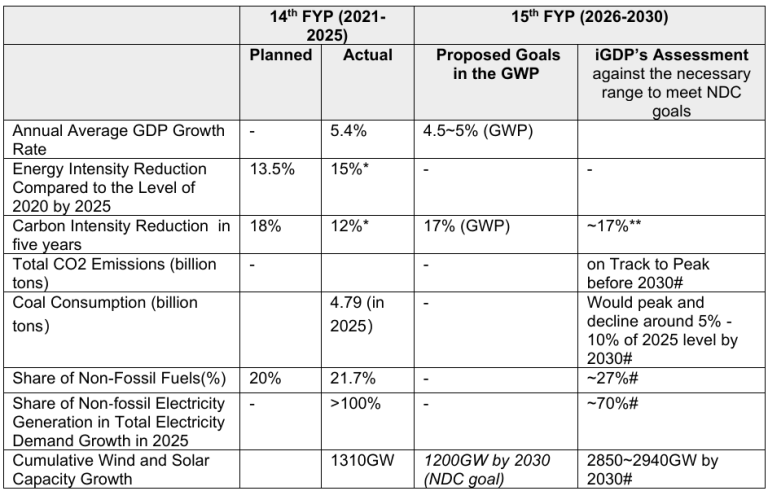
All data are from publicly available official sources, except those marked with *, **, or #.
* Our calculations, which are based on official government statistical data using the current official methodology.
** Our assessment of what is needed to meet NDC Goals.
# Our assessment of projected outputs for 2030 based on the EPS China (iGDP) model’s “policy scenario results”, with supplementary adjustments based on publicly available information.
iGDP’s reading:
The above set of targets continues China’s steady commitment to peak carbon emissions before 2030.
China’s 14th FYP carbon intensity reduction achievement fell short of the target set for 2025, though there was overperformance on all the other targets, including energy intensity reduction and renewable energy development.
China is committed to turning the coal consumption trend, although the geopolitical situation is increasing energy security concerns, not only nationally but also locally, casting uncertainty over coal reduction.
The announced GDP target is lower than previously estimated by external observers, indicating China’s determination to pursue green transition and high-quality development. This might help mitigate the surge in fossil-fuel development, partly driven by competition among local governments in the last FYP.
The Government Work Report mentions “green transition” five times and calls for “vigorously developing the green and low-carbon economy”, with emphasis on zero-carbon industrial parks, zero-carbon factories, and high-tech green sectors.
China’s groundbreaking Ecological and Environmental Code has been proposed for approval. This code includes not only existing laws, such as the Environmental Protection Law, Energy Conservation Law, and Renewable Energy Law, but also a chapter on Climate Change Abatement. Although China lacks a single climate change law, this will provide the legal foundation for China’s carbon mitigation efforts.
Q2: A central question for the global climate community is whether 2025 was China’s peak emissions year. But what are the key policies and actions most worth following that will shape China’s emissions over the next 5–10 years?
The data are not yet conclusive. More targets and policies will be included in sectoral energy and climate plans for the 15th FYP. The headline targets matter, but the real story is in the policy architecture being built to deliver them. There are five mechanisms we are watching most closely.
Shifting from energy control to carbon control: The “dual control of carbon” framework introduces carbon performance evaluations for local governments, sectoral carbon controls, enterprise-level carbon management, and product carbon footprint tracking — a substantial upgrade in the climate governance architecture. As of January 2026, all 30 provinces have released provincial-level recommendations aligned with these dual carbon pathways.
Power-market rules: Record-high renewable deployment would likely be sufficient to meet growing electricity demand and curb coal-fired power generation. The key question is whether China’s fast-growing electricity demand can be met entirely by clean electricity. This will depend on the local implementation of power-market rules to promote the direct linkage of green electricity to sectoral RPS for cement, iron & steel, aluminum, polysilicon, and data centers.
Peaking fossil fuel consumption: The 15th Five-Year Plan includes explicit language calling for both coal and oil consumption to peak during the 2026–2030 period — the first time such language has appeared in a top-level planning document. State media outlet Xinhua has suggested coal could peak around 2027, with oil peaking around 2026. A coal cap is expected to be reintroduced in the 15th FYP period after the surge in coal power plants in the past years. The political signals are real, but so are the structural headwinds.
Zero-carbon industrial parks: China has committed to building 100 zero-carbon industrial parks in the next five years. These parks have become a strategic vehicle to accelerate national green transformation, enhance global competitiveness, and address emerging regulatory and market pressures. A recent iGDP analysis shows how these industrial parks are promoting China’s vision to achieve a win-win of growth and decarbonization, while converging on integration of renewable energy systems, electrification, and industrial upgrading with a strategic focus on new energy and new materials sectors.
Non-CO2 mitigation policy: With China’s 2035 NDC now formally covering all greenhouse gases, expect new sub-targets for methane, HFCs, and N₂O to emerge in sectoral plans. The 15th FYP period is the time window to set the institutional foundation and policy framework for non-CO₂ mitigation. iGDP’s work on this area — including policy briefs on F-gases and N₂O — shows the potential is large and largely untapped.
Q3: Why do subnational climate actions matter most — perhaps more than the national targets themselves?
The national targets are only as real as their provincial implementation. The gap between what Beijing announces and what provinces deliver is where climate ambitions are won or lost.
Subnational Dual Carbon Control: The introduction of local government carbon performance evaluations under the carbon dual-control system is, therefore, potentially the most transformative governance innovation of the 15th FYP. If implemented rigorously, it creates accountability that prior energy intensity targets never achieved. iGDP’s briefing on provincial authorities’ recommendations to the 15th FYP illuminates the green transition priorities and agenda at China’s local level.
iGDP’s China Carbon Neutrality Tracker tracks these subnational actions in real time, covering policy documents, pilot programs, and sector-level innovations across 30 provinces.